New study with Wakefield Research finds 86% of in-house legal professionals now use generative AI for legal work;
54% have already reduced the volume of work sent to outside counsel;
92% are seeing AI-related cost savings from law firms
Corporate legal departments are using generative AI to take back work, cut outside counsel costs and reset how legal services are being priced, according to Everlaw, the AI litigation and investigations platform, developed with Wakefield Research. The In-House Innovation Report: Corporate Teams Gain ROI and Leverage finds that AI is now part of the daily workflow for in-house corporate legal teams, and that the balance of power between those teams and the law firms that support them is shifting as a result.
This press release features multimedia. View the full release here: https://www.businesswire.com/news/home/20261020842892/en/
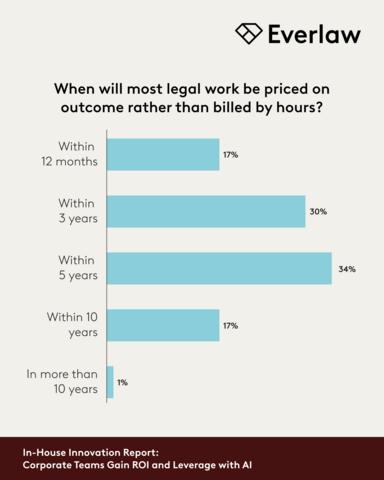
When will most legal work be priced on outcome rather than billed by hours?
The survey of 300 in-house legal professionals found that 86% now use generative AI (GenAI) for legal work, with 37% using it extensively across their workflows. That adoption is changing who holds the leverage. GenAI is enabling in-house teams to rely less on outside counsel while putting pressure on law firms to show how they use AI and pass along the savings.
“AI rebalances the relationship between in-house legal teams and their law firms,” said Gloria Lee, Chief Legal Officer at Everlaw. “As in-house teams take more control of certain types of work, our law firms can act as true strategic advisors on our highest-value challenges.”
AI Adoption Is Changing The Economics Of The Legal Profession
Among respondents whose departments use outside counsel, 54% say AI has already reduced the volume of work sent to outside counsel, and another 44% expect it to do so within the next year. Only 2% neither have reduced outside work nor expect to. The shift is sharper at departments that use GenAI extensively: 73% are already sending less work to outside counsel, and 40% anticipate bringing even more work in-house over the next 12 months.
This drives tangible economic impact. Of respondents working with law firms that use GenAI, 92% report already seeing AI-related savings from them, including 13% who describe the savings as significant and 56% as moderate. A year ago, Everlaw’s 2025 research found that 59% of in-house respondents had seen no savings from outside counsel’s AI use.
In-house teams are setting clearer expectations for how AI is used and measured. Among those who engage law firms, 62% expect clear disclosure of AI use, 61% expect measurable gains in efficiency or outcomes, and 60% expect lower fees or fewer billed hours when using AI. Law firm AI adoption is now close to universal from the client’s perspective: only 4% say their outside firms were not using GenAI, compared with 59% who didn’t know in 2025.
The Billable Hour Faces a Short Clock
Perhaps the most striking finding concerns pricing. Eighty-one percent of respondents expect outcome-based pricing to eclipse the billable hour within five years, including 47% who expect it within three years and 17% who expect it within 12 months. Fifty-seven percent expect flat or fixed fees to be the most widely adopted alternative fee arrangement from AI-enhanced work.
“In-house legal teams have the ability to drive the shift to outcome-based billing,” said Lee. “They have the motivation, which is considerable cost savings, and they have the power, because already they’re able to reduce their dependency on outside firms.”
Quality and Risk Concerns Are Growing Alongside Adoption
Respondents see GenAI as a quality tool as well as efficiency tool: 70% of those using or testing it say it has improved accuracy and consistency in legal work, slightly ahead of the 64% who cite faster task completion. But there are risks:
- Accuracy comes first. Respondents’ are more concerned about errors and misalignment (80%) and non-lawyers relying on GenAI for legal guidance (72%) versus AI taking their jobs (30%).
- Skills erosion ranks third. Sixty-three percent worry that overreliance on AI could degrade legal skills, and 68% say they are reassessing upskilling, training and headcount needs.
- Hallucinations are showing up in real matters. One third have encountered AI-hallucinated evidence or case law in litigation, including 17% from opposing counsel and 12% from their own teams.
“The erosion of legal skills isn’t something individuals can solve alone,” Lee said. “Law firms, clients, law schools, and legal tech vendors all have a role in building training models that help ensure legal professionals are elevated by AI.”
A New Division of Labor
Respondents still expect to pay law firms for judgement and expertise. In fact, 56% say clients should primarily pay outside counsel for business and commercial insight, and 54% each for managing complex matters and specialized legal expertise. Fewer than 30% pick document review (28%) or routine legal work (27%). Among litigation tasks, respondents most often expect to bring early case assessment and matter scoping (58%) and outside counsel performance and billing review (54%) in-house.
Methodology
Everlaw conducted this study with Wakefield Research to learn more about the top impacts that AI is having on corporate law departments’ operations, legal workflows, and outside counsel relationships. Responses from 300 U.S. in-house legal professionals were fielded between June 26 and July 30, 2026.
Results of any sample are subject to sampling variation. The magnitude of the variation is measurable and affected by the number of interviews and the level of the percentages expressing the results. For the interviews conducted in this particular study, the chances are 95 in 100 that a survey result does not vary, plus or minus, by more than 5.7 percentage points from the result that would be obtained if interviews had been conducted with all persons in the universe represented by the sample.
The full report is available here for free from Everlaw.
About Everlaw
Everlaw, the leading AI litigation and investigation platform, transforms raw evidence into insight and insight into strategy. Operating as the evidence layer for legal AI, our platform delivers the system of record that keeps workflows organized, highly secure, and defensible, whether work happens in Everlaw or with our extensive network of AI partners. Trusted by Fortune 100 corporate counsel, 93 of the Am Law 200, leading federal agencies, and all 50 state attorneys general, Everlaw is based in Oakland, California, and is funded by top-tier investors, including Andreessen Horowitz, CapitalG, HIG Growth Partners, K9 Ventures, Menlo Ventures, and TPG Growth.
View source version on businesswire.com: https://www.businesswire.com/news/home/20261020842892/en/
Corporate legal departments are using generative AI to take back work, cut outside counsel costs and reset how legal services are being priced, according to Everlaw
Contacts
For media inquiries contact
press@everlaw.com