Looking back on safety & security services stocks’ Q2 earnings, we examine this quarter’s best and worst performers, including CoreCivic (NYSE: CXW) and its peers.
Rising concerns over physical security, cybersecurity threats, and workplace safety regulations will present opportunities for companies in this sector. AI and digitization will enhance surveillance, access control, and threat detection, which could benefit key players in Safety & Security Services. These trends could also introduce ethical and regulatory concerns over data privacy and automated decision-making in security operations, giving rise to headline risks. Finally, increasing scrutiny on private security practices and evolving criminal justice policies again mean that companies in the space need to operate with the utmost care or risk being the poster child of abuse of power.
The 5 safety & security services stocks we track reported a strong Q2. As a group, revenues beat analysts’ consensus estimates by 3.4% while next quarter’s revenue guidance was in line.
In light of this news, share prices of the companies have held steady. On average, they are relatively unchanged since the latest earnings results.
CoreCivic (NYSE: CXW)
Originally founded in 1983 as the first private prison company in the United States, CoreCivic (NYSE: CXW) operates correctional facilities, detention centers, and residential reentry programs for government agencies across the United States.
CoreCivic reported revenues of $684.9 million, up 27.3% year on year. This print exceeded analysts’ expectations by 10.9%. Overall, it was an exceptional quarter for the company with a beat of analysts’ EPS estimates and a narrow beat of analysts’ full-year EPS guidance estimates.
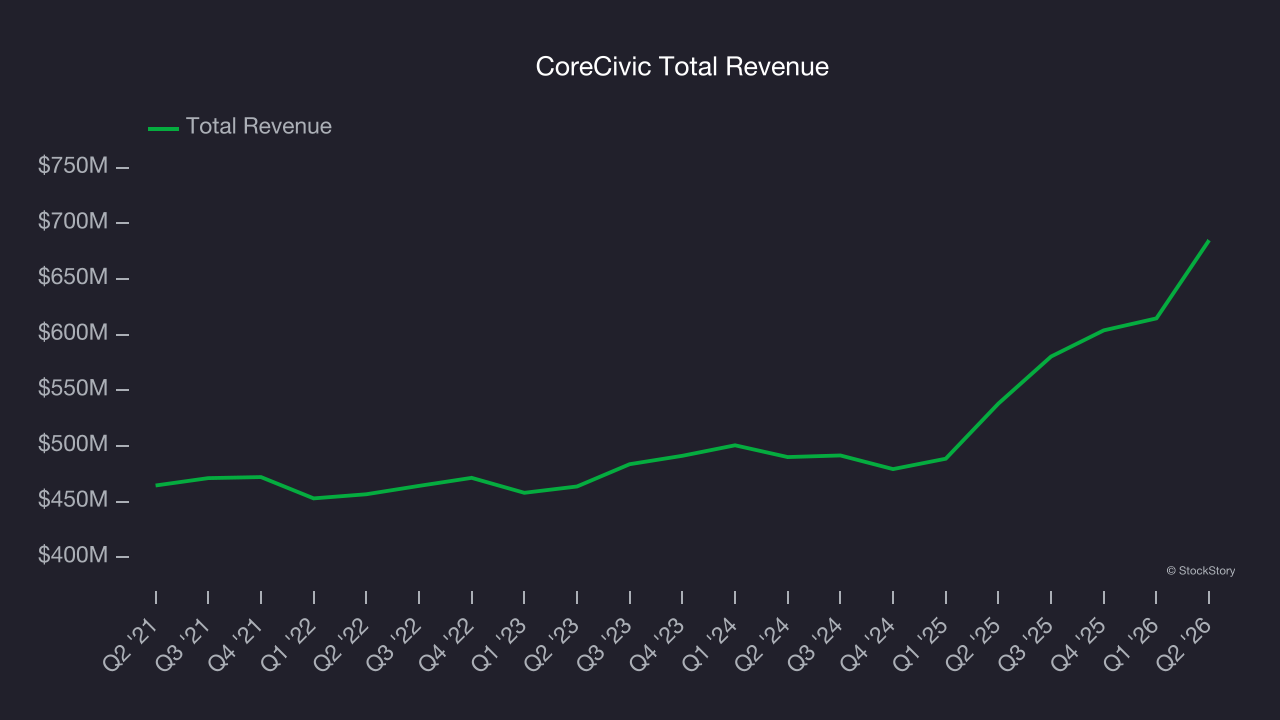
CoreCivic achieved the biggest analyst estimate beat and fastest revenue growth among its peers. Unsurprisingly, the stock is up 8.9% since reporting and currently trades at $34.02.
Is now the time to buy CoreCivic? Access our full analysis of the earnings results here, it’s free.
Best Q2: GEO Group (NYSE: GEO)
With a global footprint spanning three continents and approximately 81,000 beds across 100 facilities, GEO Group (NYSE: GEO) operates secure facilities, processing centers, and reentry services for government agencies in the United States, Australia, and South Africa.
GEO Group reported revenues of $732.1 million, up 15.1% year on year, outperforming analysts’ expectations by 1.4%. The business had an exceptional quarter with a beat of analysts’ EPS estimates and an impressive beat of analysts’ EPS guidance for next quarter estimates.
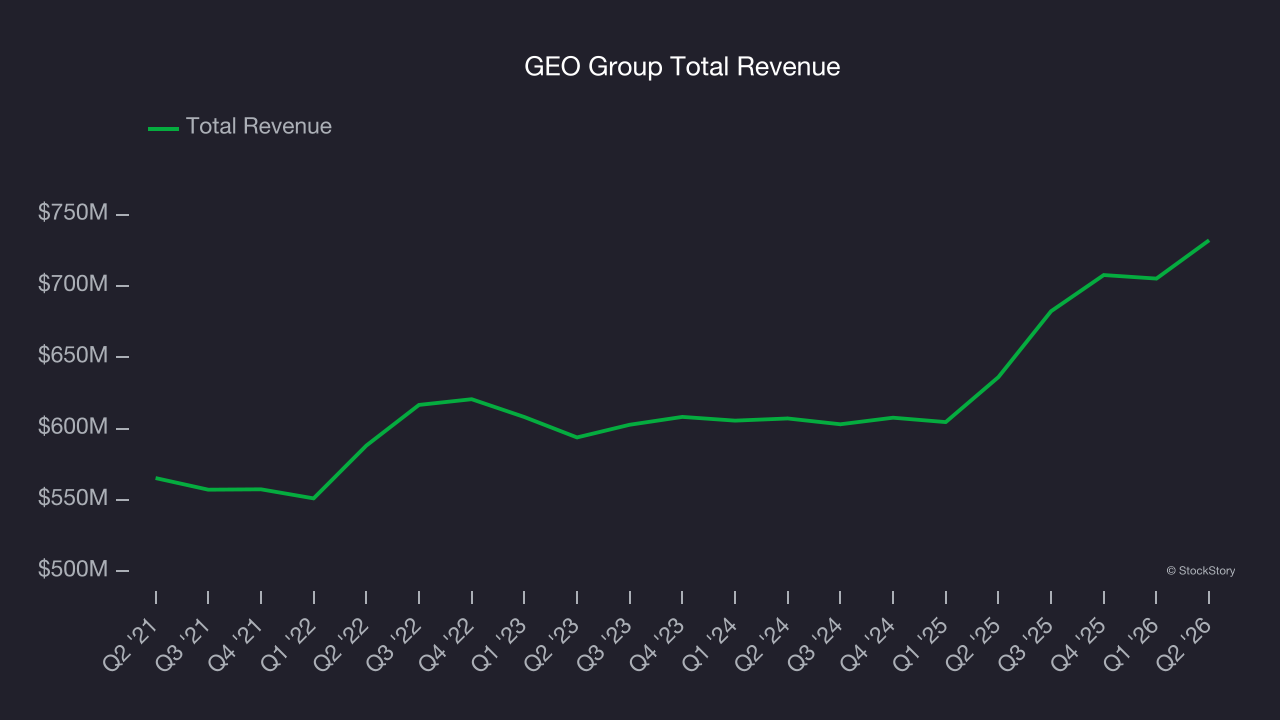
GEO Group scored the highest guidance raise in the group. The market seems content with the results as the stock is up 1.8% since reporting. It currently trades at $31.97.
Is now the time to buy GEO Group? Access our full analysis of the earnings results here, it’s free.
Weakest Q2: Brady (NYSE: BRC)
Founded in 1914 and evolving through more than a century of industrial innovation, Brady (NYSE: BRC) manufactures and supplies identification solutions and workplace safety products that help companies identify and protect their premises, products, and people.
Brady reported revenues of $436.9 million, up 10% year on year, exceeding analysts’ expectations by 2.1%. Still, it was a mixed quarter as it posted a slight miss of analysts’ full-year EPS guidance estimates.
As expected, the stock is down 5.7% since the results and currently trades at $85.01.
Read our full analysis of Brady’s results here.
Brink's (NYSE: BCO)
Known for its iconic armored trucks that have been a fixture in American cities since 1859, Brink's (NYSE: BCO) provides secure transportation and management of cash and valuables for banks, retailers, and other businesses worldwide.
Brink's reported revenues of $1.39 billion, up 7.1% year on year. This print met analysts’ expectations. Zooming out, it was a satisfactory quarter as it also logged a solid beat of analysts’ EPS guidance for next quarter estimates but revenue guidance for next quarter slightly missing analysts’ expectations.
Brink's had the weakest performance against analyst estimates of the whole group. The stock is down 11.8% since reporting and currently trades at $104.08.
Read our full, actionable report on Brink's here, it’s free.
Motorola Solutions (NYSE: MSI)
Born from the company that invented the first portable handheld police radio in 1940, Motorola Solutions (NYSE: MSI) provides mission-critical communications, video security, and command center software solutions for public safety agencies and enterprise customers.
Motorola Solutions reported revenues of $3.13 billion, up 13.3% year on year. This number topped analysts’ expectations by 4.4%. Overall, it was a strong quarter as it also put up a beat of analysts’ EPS estimates and an impressive beat of analysts’ full-year EPS guidance estimates.
Motorola Solutions scored the highest full-year guidance raise but had the weakest guidance update among its peers. The stock is up 2.3% since reporting and currently trades at $448.09.
Read our full, actionable report on Motorola Solutions here, it’s free.
Market Update
Over the past year, investors have been forced to repeatedly answer the same question: what is the market’s biggest risk? The answer has changed several times, and each shift has reshaped market leadership.
Late in 2025 and early 2026, artificial intelligence became the market’s primary uncertainty. Investors questioned whether AI would erode software pricing power and weaken competitive moats as AI made it easier to replicate once-differentiated products.
By the spring, technology took a back seat to geopolitics. The U.S. conflict with Iran briefly became the market’s dominant narrative, raising concerns about oil prices, inflation, and global growth. But as energy markets remained orderly and fears of a prolonged supply disruption faded, investors quickly turned their focus back to fundamentals.
Want to invest in winners with rock-solid fundamentals? Check out our Top 5 Quality Compounder Stocks and add them to your watchlist. These companies are poised for growth regardless of the political or macroeconomic climate.